
As night falls across
Africa bustling cities light up and neighbourhoods begin to buzz, fed by
traffic from well-lit roads. In the countryside, meanwhile, villages are
plunged into darkness, shutting down the night-time economies of rural
communities as restaurants and shops close and children light candles to do
their homework.
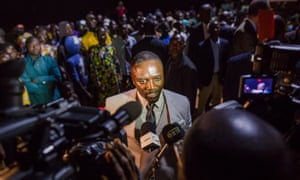
For Akon, the US-based
rap star, the realities of living without electricity are a vivid memory from
his youth growing up in Kaolack, southern Senegal. Today, 600 million African
people still live without access to electricity, and 3.5 million people die
each year from inhaling toxic fuels or house fires caused while trying to light
their homes. The project Akon Lighting Africa aims to tackle the problem using
a different approach to the usual methods of NGOs in Africa.
Akon and his two
co-founders, Thione Niang, a Sengalese political activist and Samba Bathily, a
Malian entrepreneur and CEO of the solar energy company Solektra International,
believe that what rural African communities need is not overseas charity but
affordable renewable energy delivered by fully trained African professionals
managing for-profit projects that bring longevity, generate jobs and build new
self-sustaining economies. They think this initiative could mark the beginning
of an African energy renaissance in which the continent becomes the focal point
of a global solar power industry.
One thing I’ve realised
about Africa is that only the organisations that involve Africans themselves
are successful.
For Akon, this second
venture into development (he also founded Konfidence, a health and education
charity) has been an eye-opener. “There have been a lot of issues and
challenges that I honestly wasn’t aware of until I got involved,” says the
42-year-old rapper, who has just completed a Canadian tour and spent the summer
on a roadshow with Bathily and Niang that took him from the Global
Entrepreneurship Summit in Nairobi, through Rwanda, Congo-Brazzaville, Nigeria
and Niger, culminating at the coastal city of Cotonou, Benin, where they
inspected Akon Lighting Africa’s projects.
Join up to access
commentary and insight from development experts across the world.
“One thing I’ve realised about Africa is that
only the organisations that involve Africans themselves are successful. A lot
of corporations that come with their own policies and try and implement them in
Africa fail horribly. The advantage we had is that all three founders are
African, so we were able to navigate through each country a lot faster.”
Niang and Bathily bring
political and economic skills to the project, while Akon admits that his main
contribution is his name and the marketing opportunities it brings.
The founders have
already made deals with the governments of 16 African states and aim to be
operating in 25 by the end of next year. The deals are pre-financed using a
$1bn credit line funded by international partners, including China Jiangsu International
Group, and distributed by the pan-African bank Ecobank. A Chinese manufacturer
supplies the solar panels but, crucially, the workers are predominantly
African. The pre-financing set-up means that Solektra International can begin
the engineering work straight away, giving villagers immediate electricity.
Repayment plans are worked out with individual governments on a case-by-case
basis.
Humanitarian system
'stretched to its limits' says new research
The deals are
delivering three types of solutions for people without electricity: 100,000
street lamps are being installed in villages; 1,000 solar micro-generators will
act as clean energy hubs for communities, replacing old generators that used
fossil fuels; and 200,000 household solar electric systems - including devices
that store energy to provide LED panel lighting at night and pocket-sized solar
gadgets that charge phones and tablets - will be sold at affordable prices to
families, subsidised by each African government or local authority. It is a
for-profit business, with Solektra negotiating rates with each government to
meet affordability targets and with payments structured to ease burdens on
national budgets.
“Personally, I don’t
think that charities in Africa really work,” says Akon. “I think it just holds
the people down longer than it should. I think the only way to build Africa is
to build for-profit businesses that create opportunities and jobs for the
people locally. That’s why with Akon Lighting Africa we decided to take a
for-profit approach. Ultimately, it’s providing empowerment to local people so
they can start developing their own economies.”
Can technology free
developing countries from light poverty?
To that end, the
organisation is a month away from launching an academy in Bamako, Mali where
young people will train in construction, engineering, clerical work and project
management.
“When we launched we
sent 20 young people from 10 African countries to university in Marrakech with
a scholarship fund to complete the engineering programme and then come back and
work for us,” says Niang. “But we then realised this was bigger than that so we
set up the academy in Mali.”
However, the project is
not entirely bypassing NGOs. Niang’s non-profit Give1Project specialises in
mentoring social entrepreneurs and has been key in mobilising young,
enthusiastic recruits who carry out the legwork and receive valuable training
and employment in return.
“What happens usually
is that when people come to do business in Africa, they bring the expertise
with them but they also bring the workers, and once they’re done they’re gone,”
says Niang. “That’s why many cities in Africa have a lot of solar lights but
after three years none of them work and nobody is there to maintain them. So we
thought it was important to train the young Africans in the local areas. And
it’s important to give jobs to young people.”
African governments must urgently invest in
science and research
Their efforts have been
well received by governments seeking greater energy access but struggling to
find reliable partners. Akon Lighting Africa holds direct meetings with the
countries’ leaders, then with the energy ministers, then with finance ministers
and then they set up pilot projects before discussions about increasing scale.
Akon Lighting Africa
focuses on rural areas because that’s where the need is greatest. “If you want
to make an impact start there,” Akon says. “My thinking is if you want to build
Africa, you start from the rural areas because that is the heartbeat of
Africa.”
The Guardian

No comments:
Post a Comment